
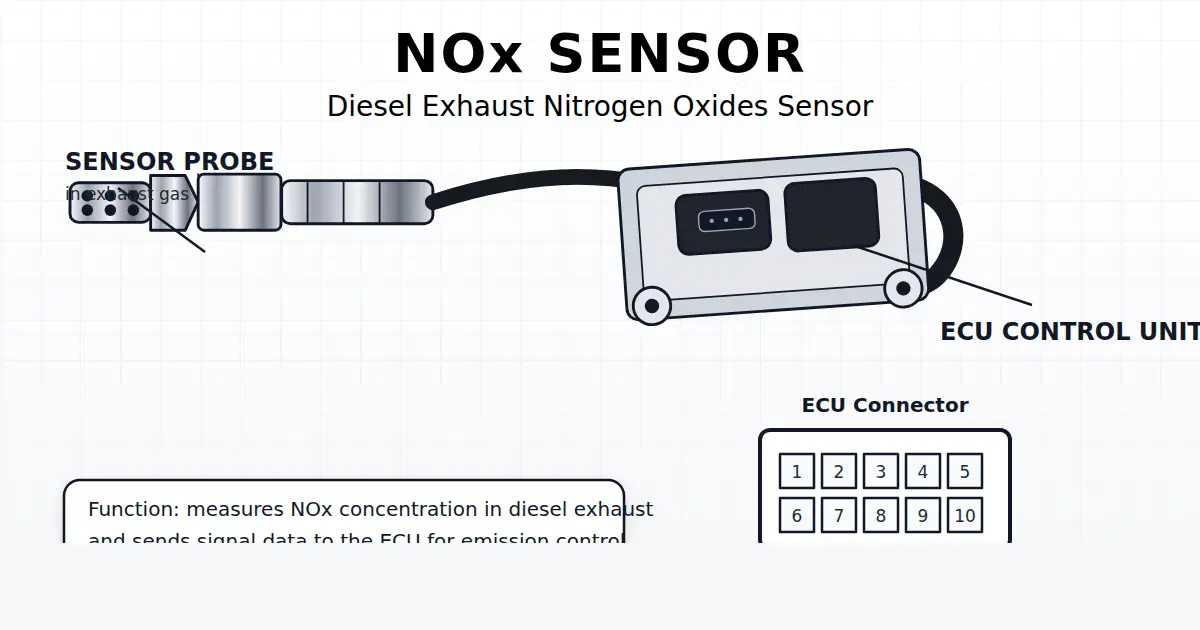
What happens when a NOx sensor fails mid-route
Modern diesel engines treat the SCR system as load-bearing equipment. When a NOx sensor stops reporting, the ECU loses its main feedback signal for DEF dosing, and most trucks respond with an escalation sequence: a dashboard warning first, then a countdown timer, then a torque or speed limit. Since the 2010 model year, federal rules have required new heavy-duty diesels sold in the US to use these operator inducements, including speed restriction, when the emissions control system stops working properly. The exact thresholds differ between engine makers, but the pattern is the same everywhere. Ignore the fault long enough and the truck decides for you.
I mention this because plenty of owner-operators still treat a NOx code as something to clear with a scan tool and forget about. That works once, maybe twice. The sensor does not heal itself, and every restart of the countdown burns goodwill you will want later, ideally not at 2am outside Joplin.
The costs that never show up on the parts invoice
The sensor itself might be a few hundred dollars. The downtime is where the money goes. When we talk with fleet buyers, these are the line items they actually complain about:
- A tow or mobile technician call-out, which starts around $150 and climbs fast after hours
- Driver hours paid while the truck sits, or worse, a driver stranded overnight with hotel and deadhead costs
- Late delivery penalties or a lost customer relationship when the load misses its window
- Rental or borrowed equipment to cover the route
- A second shop visit because the first diagnosis blamed the sensor when the real fault was a corroded connector or chafed harness
Run a simple example. A regional hauler with one tractor down for three days loses three days of revenue on that unit. If the truck normally grosses $1,800 a day after fuel, the outage costs more than $5,000 before anyone touches a wrench. Even a modest NOx sensor, in other words, can quietly become your most expensive part of the quarter. We see fleets underestimate this consistently, especially smaller ones without a maintenance planner tracking out-of-service days per unit.
Why the repair takes longer than it should
Two things slow down NOx sensor repairs. The first is diagnosis. Sensor codes often overlap with wiring faults, poor connections, contaminated DEF, or a failing pump, so shops that swap the sensor without checking the circuit sometimes eat a second failure. The second is parts supply. Certain OE sensor numbers sit on backorder for weeks, and the aftermarket shelf is uneven. Some replacement sensors pass bench checks but drift out of spec within months because the probe ceramics or the sensing element were never validated against OE tolerances.
Both problems have the same fix: buy tested parts from a source that stands behind them, and stop treating the sensor as a mystery black box. It is a consumable with electronics inside, nothing more.
A replacement strategy worth copying
- Treat NOx sensors as planned replacements, not surprise repairs. Heat cycling and soot exposure set the clock, and units on high-idle or hot-duty applications tend to fail sooner than the calendar suggests.
- Log every install. Serial number, date, odometer, and truck number. Patterns appear quickly once you track them, and they tell you when to replace the remaining units in that cohort before they strand drivers.
- Stock one spare for every five to eight trucks in the same platform. A shelf spare converts a multi-day outage into a two-hour job.
- Verify fitment by OE cross-reference, not by photo. Sensor housings look alike across manufacturers; the connector pinout and calibration do not transfer.
Where SHR fits into this picture
We build and supply NOx sensors for more than 900 applications, produced under our IATF 16949 certified quality system and matched to OE part numbers before anything ships. Every unit is checked against OE specifications, and we support sample orders so you can validate a sensor on one truck before you commit a fleet to it. For distributors and larger fleets, bulk RFQ pricing is available directly through our sales team. No drama, no minimum order games.
Frequently asked questions
Can I keep driving with a failed NOx sensor?
For a short period, yes, but most trucks start a derate countdown within hours of the fault appearing. Once the timer runs out, the engine limits torque or road speed, sometimes as low as 5 mph. Plan the repair before the inducement locks you into whatever shop happens to be nearby.
Are aftermarket NOx sensors reliable?
They vary widely. The difference is validation: whether the supplier tests each unit against OE output curves and temperature tolerances, or just packages a compatible-looking housing. Ask for the test process in writing before ordering.
How long does a NOx sensor replacement take?
The physical swap is usually under two hours on most Class 8 platforms. Diagnosis adds time if the fault involves wiring or the DEF system, which is why a shop familiar with your engine brand pays for itself here.
NOx Sensor Solutions
Continue from this guide to NOx sensor cross-reference, application support, and RFQ-ready product sourcing.
Need OEM cross-reference or wholesale pricing?
Send part numbers, applications, or sourcing requirements to SHR Autoparts for a faster B2B response.