
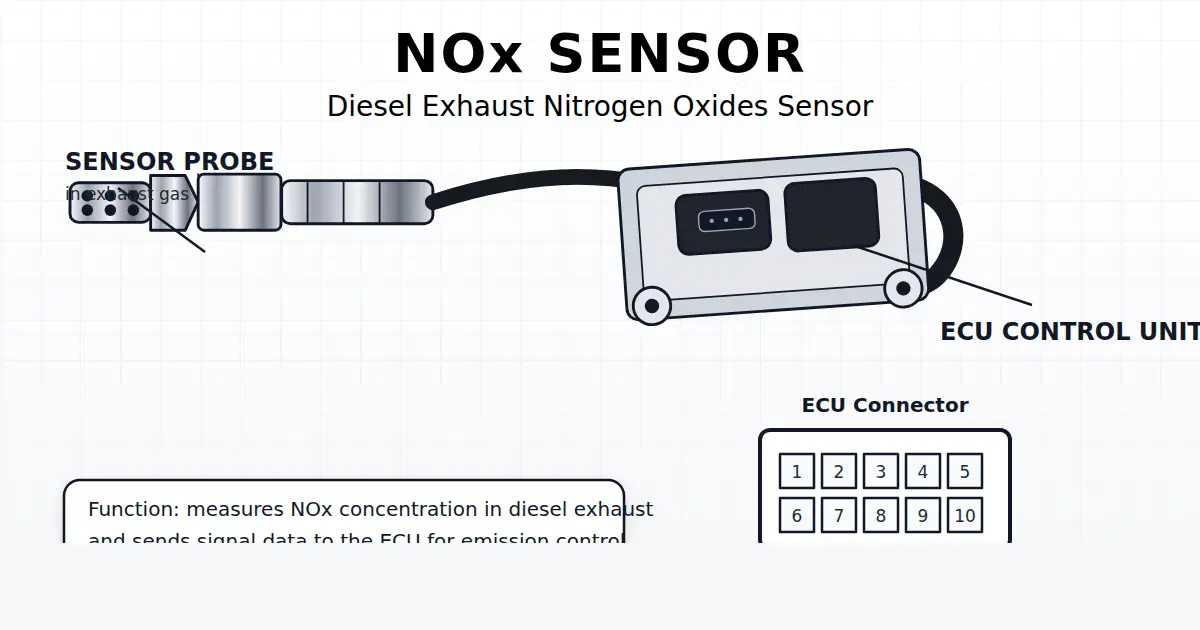
What a NOx sensor measures, and why it is hard
Most diesel technicians treat the NOx sensor as a black box. You see a fault code, you swap the part, and the warning light goes out. But the sensor is doing real physical chemistry inside your exhaust, and understanding that work explains why some replacements last while others fail within a season. This article walks through how a modern NOx sensor actually measures nitrogen oxides, and what it means when you buy them.
The two-cell amperometric design
A NOx sensor reports the concentration of nitrogen oxides in exhaust gas, usually in parts per million. The hard part is that the gas is hot, wet, and full of oxygen. Free oxygen sits at thousands of ppm, far above the NOx you actually care about. A sensor that simply reacted to oxygen would be useless, so the design strips the oxygen out first, then looks at what nitrogen oxides remain.
Inside the sensor are two small electrochemical chambers built from yttria-stabilized zirconia, the same ceramic family used in lambda sensors. The first chamber is the pump cell. A controlled voltage drives oxygen ions through the zirconia, pulling free oxygen out of the sample until the local oxygen level drops close to zero.
The gas then reaches the second chamber, the measurement cell. A catalytic electrode, typically rhodium, breaks the NOx molecules apart. The nitrogen stays behind while the released oxygen is pumped back across the zirconia. The current needed to pump that oxygen is directly proportional to the NOx concentration. In effect, the sensor counts the oxygen that was chemically bound inside the NOx, which is a neat way to isolate it from the much larger pool of free oxygen.
The heater and why temperature matters
None of this works cold. The zirconia cells only conduct ions above roughly 600 degrees Celsius, and most designs run around 700. A built-in heater brings the tip up to temperature within a minute of starting the engine. If the heater circuit fails, the cells go inert, the ECU sees no valid signal, and on most trucks that triggers a fault plus a power-limited limp mode. This is why heater resistance is the first value a diagnostic scan checks.
Why reference air and calibration matter
The measurement cell needs a clean internal reference, so the sensor draws a small amount of ambient air down a reference channel. Contamination there, or a leak in the reference path, shifts every reading the sensor reports. Good units are calibrated against known gas mixtures at the factory, and the ECU applies the sensor’s stored correction factors. When an aftermarket copy skips this step, the readings drift and the SCR system downstream starts dosing urea on bad information.
What this means when you source replacements
The details above are exactly where replacement quality shows. A sensor that uses the right ceramic, the right rhodium electrode, and a properly controlled heater will track the original within a few percent. A cheap copy often uses a weaker heater or a thin electrode layer, and it drifts as the part ages. For fleets that face periodic emissions testing, a low-reading sensor is not a small nuisance. It under-doses DEF, tailpipe NOx climbs, and the truck fails the test months after the part was installed.
SHR Autoparts builds its NOx sensor line under IATF 16949 process controls and keeps OE matching for more than 900 diesel models. In our view, fleet managers get the best result by ordering a sample against a specific VIN before a bulk RFQ, because connector shape and sensor length vary more than the label implies. If you run mixed makes, send us the OE number and we can cross it against our catalog the same day.
Frequently asked questions
Can a NOx sensor tell NO and NO2 apart?
Most heavy-duty NOx sensors report total NOx. The decomposition electrode converts NO2 into NO and then breaks it down, so the reading sums both gases. If your application needs the NO versus NO2 split, that requires a different sensor architecture, not a software tweak.
Why does a failed heater cause a power-limited mode?
The zirconia cells need about 600 degrees Celsius to conduct ions. With no heater current, the sensor cannot pump or measure, so the ECU has no exhaust NOx data to manage SCR dosing. Rather than guess, it limits engine power and flags the driver. Check heater resistance before assuming the sensing element is dead.
Is an aftermarket NOx sensor good enough for emissions compliance?
A well-made unit that matches the OE design holds within a few percent under steady conditions, which is enough for normal SCR operation. The real risk is drift over time. We see cheap copies lose accuracy after a few months of thermal cycling, and that is when compliance problems show up. Match the design, not just the connector.
NOx Sensor Solutions
Continue from this guide to NOx sensor cross-reference, application support, and RFQ-ready product sourcing.
Need OEM cross-reference or wholesale pricing?
Send part numbers, applications, or sourcing requirements to SHR Autoparts for a faster B2B response.