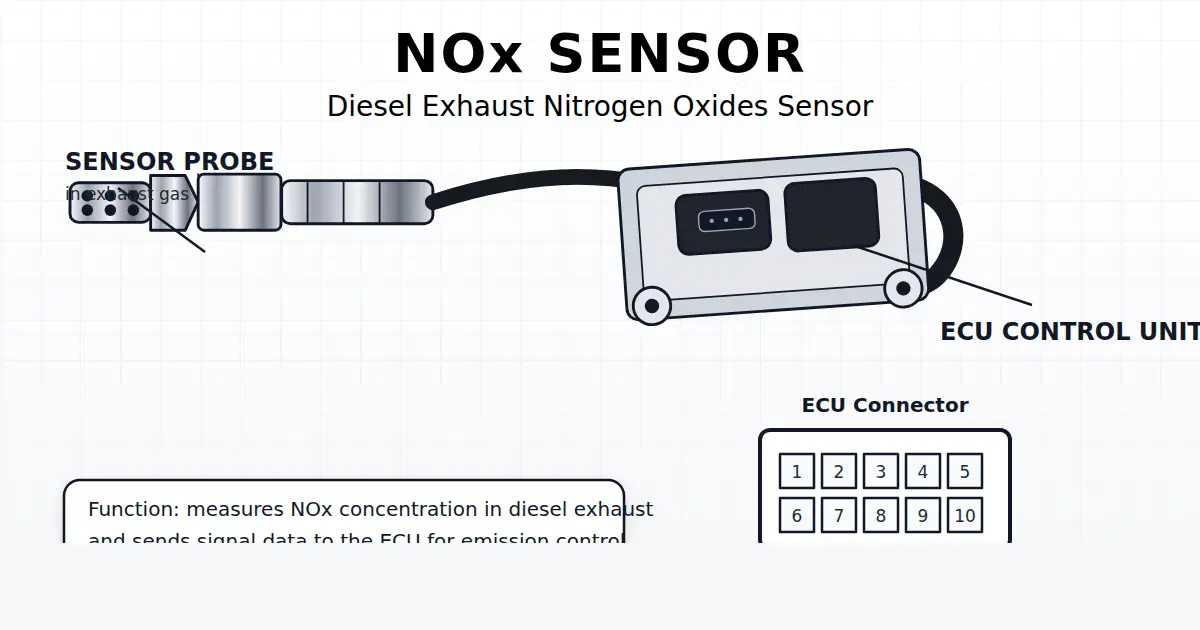
A NOx sensor (nitrogen oxide sensor) is a key emissions component on modern diesel trucks, buses, and off-road engines. It measures the level of NOx in the exhaust stream so the engine control unit (ECU) can regulate the selective catalytic reduction (SCR) and exhaust gas recirculation (EGR) systems. When the sensor drifts out of spec or fails, the vehicle loses the feedback it needs to control emissions, which usually triggers a warning light, reduced performance, or a failed emissions test.
\n\n
This guide explains how a NOx sensor works, the six most common failure symptoms, the OBD-II fault codes you are likely to see, what causes the failure, how to diagnose it, and how to choose the correct replacement for your application.
\n\n
What does a NOx sensor do?
\n
Most diesel applications use two NOx sensors: one upstream (before the SCR catalyst) and one downstream (after it). Each sensor reports real-time NOx concentration (in ppm) to the ECU. The control unit compares the two readings to calculate conversion efficiency and adjust DEF (AdBlue/Urea) dosing, injection timing, and EGR rate. A reliable NOx sensor is what keeps the engine inside legal emissions limits while protecting fuel economy and power.
\n\n
6 Common symptoms of a failing NOx sensor
\n
- \n
- 1. Check Engine or Emissions Warning Light. The most obvious sign. A faulty sensor usually sets a fault code that illuminates the dashboard lamp.
- 2. Reduced Fuel Economy. Without accurate NOx feedback, the ECU often runs a richer or more conservative strategy, increasing diesel consumption.
- 3. Loss of Power / Limp Mode. Many engines enter a protective “limp home” state when NOx control is lost, capping RPM and speed.
- 4. Failed Emissions or Smoke Test. Inaccurate sensor data can push NOx output above the limit, failing mandatory testing.
- 5. Abnormal DEF / Urea Consumption. A drifting sensor can cause over- or under-dosing of DEF, leading to crystallisation or excessive fluid use.
- 6. Visible Exhaust Smoke or Odour. Poor closed-loop control can let unburnt or high-NOx exhaust pass through.
\n
\n
\n
\n
\n
\n
\n\n
Common NOx sensor fault codes (OBD-iI)
\n
NOx sensor faults fall in the P2200, P229F range. The exact code depends on the bank, sensor position (upstream/downstream), and manufacturer, but the pattern is consistent:
\n
| Code Family | Meaning |
|---|---|
| P2200 / P2201 / P2202 / P2203 | NOx Sensor Circuit (Bank 1, Sensor 1): range/performance, signal, low, high |
| P2209 / P2210 / P2211 / P2212 | NOx Sensor Heater Control Circuit (Bank 1, Sensor 1) |
| P229F / P229E | NOx Sensor Exhaust Sample Cross Count / Circuit (Bank 1, Sensor 2) |
| P22xx (Sensor 2) | Downstream sensor circuit / heater faults (after SCR catalyst) |
\n
Note: code definitions vary by manufacturer (Mercedes, Cummins, Volvo, etc.). Always confirm against the specific OEM fault tree before replacing parts.
\n\n
What causes NOx sensor failure?
\n
- \n
- Contamination. Oil ash, soot, coolant, or fuel residue coats the sensing element and degrades accuracy.
- Thermal Shock. Repeated extreme temperature swings crack the ceramic and the internal heating element.
- Moisture Ingress. Failed seals or connector corrosion short the sensor circuitry.
- Age & Mileage. Like any emissions sensor, NOx sensors wear and drift after years of service.
- Wiring & Connector Damage. A broken harness or corroded plug can mimic a sensor failure.
\n
\n
\n
\n
\n
\n\n
How to diagnose a bad NOx sensor
\n
- \n
- Read the fault codes with an OBD-II or OEM-grade scanner to identify which sensor and circuit is flagged.
- Check live data. Compare upstream vs. downstream NOx ppm readings; a stuck, flat, or implausible value points to the faulty sensor.
- Inspect the wiring and connector for corrosion, melting, or loose pins before assuming the sensor itself is bad.
- Verify heater circuit with a multimeter if a heater-related code is present.
- Cross-reference the OE number so you order the exact fitment the first time.
\n
\n
\n
\n
\n
\n
You can search our catalogue by OE number, vehicle brand, or model directly from the header search:
\n
🔍 NOx Sensor 🔍 Mercedes 🔍 Cummins
\n\n
How to choose the right replacement NOx sensor
\n
Choosing the correct unit comes down to four checks:
\n
- \n
- Match the OE number exactly. The stamped OE reference is the most reliable way to guarantee fitment and protocol.
- Confirm brand & model year. Sensor calibration differs between Mercedes, Cummins, Volvo, Scania, DAF/PACCAR, Hyundai, and others.
- Pick the correct position. Upstream and downstream sensors are not always interchangeable.
- Verify quality. Use OEM-equivalent sensors with the right connector, cable length, and heater spec.
\n
\n
\n
\n
\n
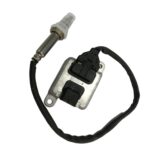
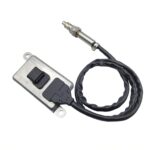
Below are a few popular NOx sensors from our catalogue to show the kind of cross-reference data we provide:
\n
Looking for a specific brand? Open the relevant coverage page:
\n
- \n
- Mercedes-Benz NOx Sensors
- Cummins NOx Sensors
- Volvo NOx Sensors
- Scania NOx Sensors
- DAF & PACCAR NOx Sensors
- Hyundai NOx Sensors
\n
\n
\n
\n
\n
\n
\n\n
Frequently asked questions
\n
Can I keep driving with a bad NOx sensor?
\nShort distances may be possible, but most engines limit power or block regeneration once the fault is active. Continuing to drive risks higher emissions, poor fuel economy, and potential damage to the SCR system.
\n
OEM or aftermarket?
\nA high-quality OEM-equivalent sensor with the correct protocol and connector is usually the best balance of reliability and cost. Always match the OE number first.
\n
How long does a NOx sensor last?
\nTypically 80,000–150,000 km under normal duty, but harsh duty cycles, contamination, and thermal stress can shorten that significantly.
\n\n
Get the right NOx sensor
\n
If your dashboard light is on or your vehicle has failed emissions, send us the OE number and we will match the correct NOx sensor for your truck or engine. Browse the full range or request a bulk quote for fleet or service-centre volumes.
\n
Explore all NOx Sensor solutions →
\n
NOx Sensor Solutions
Continue from this guide to NOx sensor cross-reference, application support, and RFQ-ready product sourcing.
Need OEM cross-reference or wholesale pricing?
Send part numbers, applications, or sourcing requirements to SHR Autoparts for a faster B2B response.